
Facebook Ads: Navigating New Advertising Rules
If you’ve ever launched a Facebook advert and thought.. “I’ll just target divorced homeowners in Bristol who’ve recently inherited a three-bedroom semi and are thinking about downsizing while drinking Yorkshire Tea…” …we’ve got some news that Meta has other ideas.
For businesses in financial services, regulated industries and Sale and Rent Back (SARB), Facebook advertising isn’t quite the laser-guided targeting machine it once was. In fact, if you’re advertising anything related to buying, selling or financing property, you’re playing by an entirely different set of rules. Before you panic and throw your marketing budget into the nearest harbour, don’t worry. It doesn’t mean Facebook advertising doesn’t work, it simply means the way you make it work has changed. And, believe it or not, it’s probably made marketers better
Facebook Knows Less About Your Customers... On Purpose
There was a time when digital marketers could become frighteningly specific. Age, Gender, Relationship status, Life events, Home ownership, Interests, Favourite biscuits… (OK, maybe not the biscuits.)
Today, property advertising falls under Meta’s Housing Special Ad Category. That means advertisers lose access to many of the targeting tools they’ve become used to. No age targeting, no gender targeting, no postcode radius, no life-event targeting & no Lookalike Audiences. So, despite what Hollywood might suggest, we can’t ask Facebook to find:
- People going through a divorce.
- Someone who has recently inherited a property.
- Homeowners worried about repossession.
- Empty nesters looking to downsize.
Instead, Meta encourages a broader, fairer approach that helps reduce discrimination in housing advertising. Frustrating? Sometimes. A good thing? Also yes. Because when everyone is forced to play by the same rules, good marketing starts to matter a lot more than clever targeting.
Your Creative Has Become Your Best Salesperson
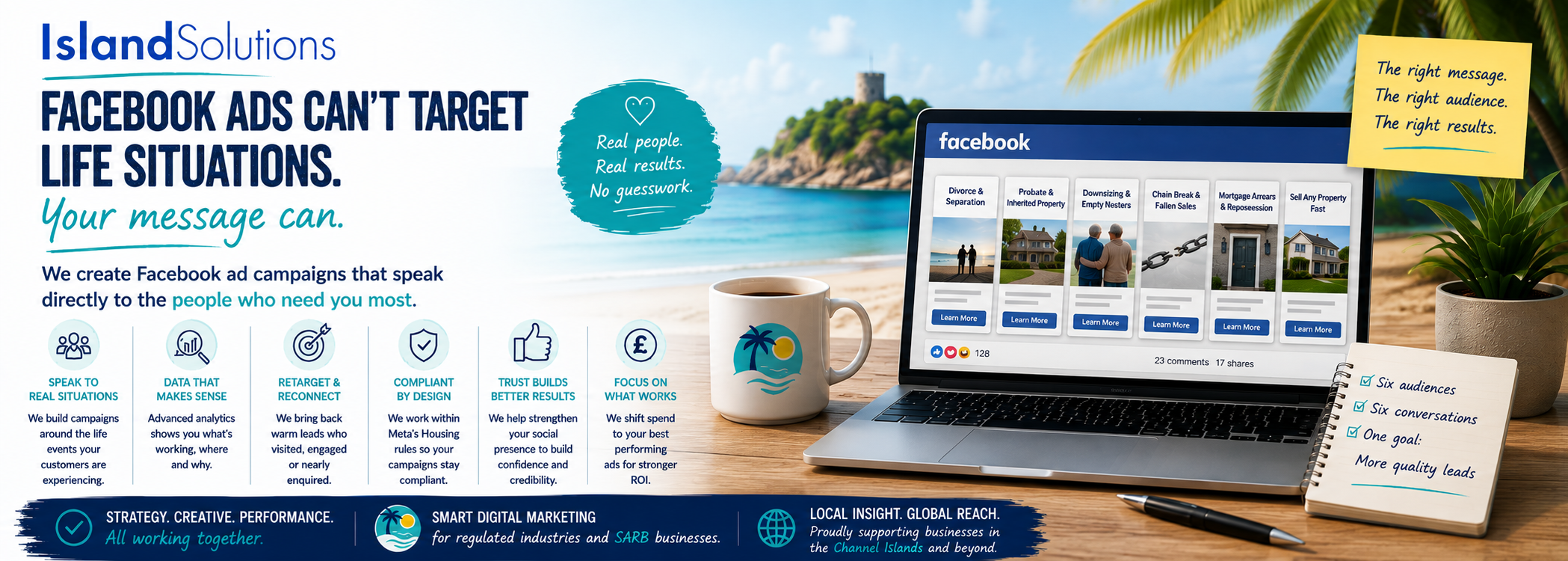
Here’s the funny thing, although Meta won’t let us target someone because they’re going through probate…someone going through probate is still far more likely to stop scrolling when they see an advert that talks directly about inherited property. So that’s the real magic, the advert becomes the targeting. Instead of asking Meta to find the audience, we create messages that naturally attract the people they’re written for. Imagine six different adverts, one speaks about divorce, another talks about inherited property, another explains repossession, another focuses on broken property chains, another reassures people wanting to downsize, and another simply offers a quick, straightforward property sale. They all run across broadly the same geography. Yet each one attracts completely different people. Not because Facebook knows everything, but because good messaging speaks to real situations. That’s why we often recommend structuring campaigns around customer circumstances rather than trying to force impossible audience targeting.
Good creative is becoming the new audience selection.
One Campaign. Six Conversations.
One mistake we regularly see is businesses squeezing every advert into one giant campaign. Everything gets mixed together, every click & every pound spent. Eventually you know your campaign generated enquiries…but you’ve absolutely no idea why. That’s a bit like baking six different cakes, throwing them into one blender and asking people which recipe tasted best.
Instead, separating campaigns by customer need gives you genuine insight. Which message is generating the cheapest enquiries? Which location performs best or which life situation prompts the strongest response? Maybe probate adverts outperform everything else, or maybe downsizing generates fewer enquiries but much higher-quality leads.
Maybe the “sell any property quickly” advert simply creates awareness that feeds every other campaign. Without separating those messages, you’ll never know, marketing isn’t just about generating clicks, it’s about learning.
Data Is Clever. Analytics Are Even Cleverer.
This is where digital marketing analytics quietly become one of the most valuable members of the team. Running adverts isn’t difficult., but understanding why one advert succeeds while another quietly disappears into Facebook’s newsfeed is where the real value lies! Modern analytics allow us to follow a customer journey from advert to enquiry. We are all looking for answers on that marketing budget:
- Which advert caught their attention?
- Which landing page converted them?
- How many called instead of completing a form?
- Which campaign generated the best return on investment?
With proper tracking through Meta Pixel, the Conversions API and campaign tagging, businesses stop relying on guesswork and start making decisions backed by evidence. The best part is that analytics often tells a completely different story from instinct. That advert everyone loved in the boardroom, is sometimes it’s the worst performer.
Meanwhile, the straightforward, slightly less glamorous advert quietly generates the majority of enquiries. Data doesn’t have an ego, which is probably why marketers should listen to it a little more often.
Don't Forget the People Who Nearly Said Yes
Here’s a statistic that marketers have known for years… most people don’t convert on their first visit.
Life gets in the way! The phone rings, the dog starts barking, someone remembers they’ve left the oven on, or they simply aren’t ready. That doesn’t mean they’re lost, it means they’re warming up.
That’s exactly why retargeting works so well, if someone has visited your website, watched your video or engaged with your advert, they’re already familiar with your business. Instead of disappearing forever into the internet abyss, retargeting gives you another opportunity to say:
“Still thinking about selling? We’re still here.”
It’s one of the simplest ways to improve campaign performance without dramatically increasing advertising budgets. Sometimes customers don’t need convincing, they simply need reminding.
Paid Ads Build Awareness. Trust Closes the Deal.
Imagine clicking on a property advert, the website looks great & the messaging feels reassuring, everything seems professional, but then you click on the company’s Facebook page and discover their last post was sometime around the London Olympics! For businesses operating in sensitive sectors like SARB, probate or repossession, trust matters just as much as visibility. Customers aren’t simply buying a product, they’re often making one of the biggest financial decisions of their lives. They’re looking for reassurance, and they want to know there’s a real business behind the advert.
That’s why even a simple organic social presence makes such a difference. A few customer stories, some helpful advice, or straightforward explanations, a glimpse of the people behind the business. Nothing flashy, but just enough to reassure prospective customers that they’re dealing with genuine people who understand their situation. Sometimes your Facebook page isn’t there to generate leads, it’s there to answer the silent question every customer asks: “Can I trust these people?”
Facebook advertising hasn't become harder, it's become smarter.
Success is no longer about finding loopholes in audience targeting or relying on complicated demographic filters. It’s about understanding people, and creating messaging that speaks directly to their circumstances. Using analytics to learn what’s genuinely working, and retargeting those who need a little longer to decide. And supporting every paid campaign with the trust signals customers expect before making life-changing decisions.
At Island Solutions, we believe the best digital marketing doesn’t interrupt people. It helps them because whether you’re working in regulated financial services or property, trust has always been your most valuable asset. Facebook just happens to have found another way of reminding us.