
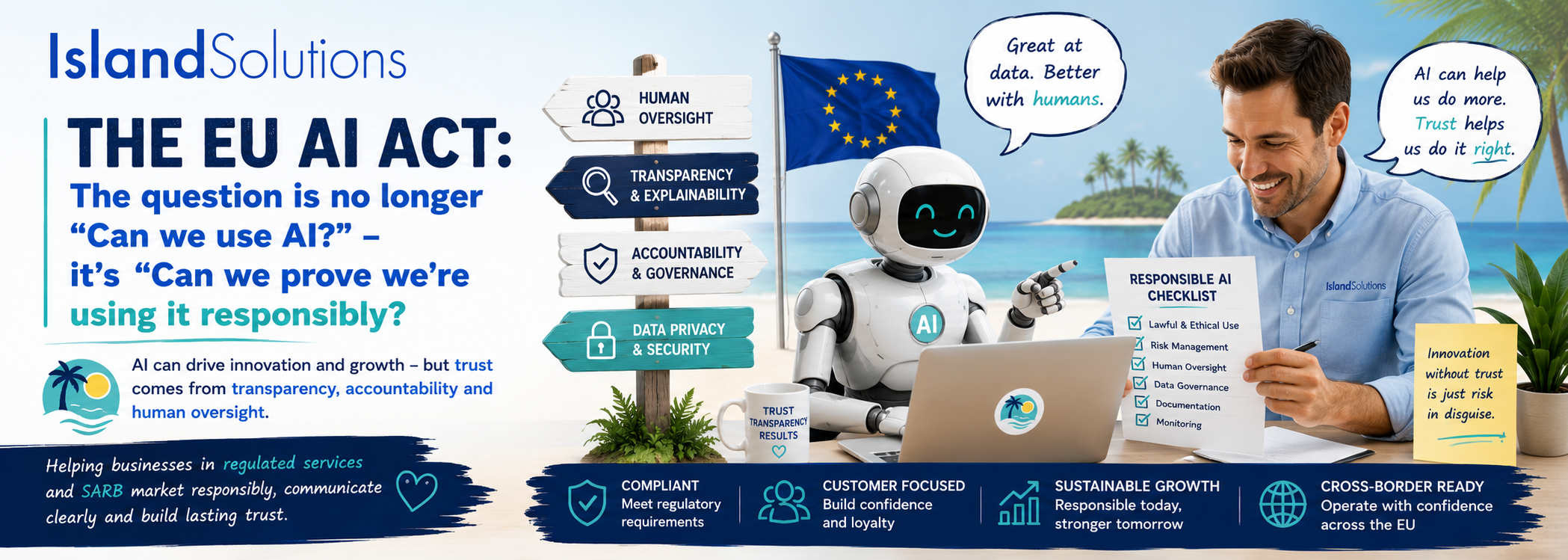
Understanding the EU AI Act: Trust and Compliance in AI Usage
Artificial Intelligence has had quite the glow-up. A couple of years ago, businesses were nervously asking “Can we use AI?” Then everyone discovered ChatGPT, image generators, AI assistants, automated content tools, and enough AI-powered software to fill several exhibition halls and at least three LinkedIn feeds. Now, the question has changed. Particularly for businesses operating in regulated sectors, financial services, and Sale and Rent Back (SARB). The question is no longer “Can we use AI?” It’s “Can we prove we’re using it responsibly?”
And that’s where the newly introduced EU AI Act starts to become very interesting. While many organisations are still experimenting with AI, regulators are increasingly asking businesses to think beyond efficiency and focus on transparency, accountability, and trust. The Act is designed to encourage trustworthy, human-centric AI while protecting people from harmful uses of the technology.
Thankfully, this isn’t the end of AI innovation, far from it. It’s simply the start of AI growing up.
The AI Gold Rush Is Over
Let’s be honest, the past couple of years have felt a bit like the Wild West. Every software provider suddenly became an “AI-powered platform”. Every marketing agency was apparently “revolutionising customer engagement”. Every business owner knew somebody who knew somebody who’d written a blog post in 14 seconds using AI and somehow become an industry thought leader overnight.
The excitement was understandable, AI can genuinely save time, improve productivity, support customer service, and help businesses deliver better experiences. The EU AI Act recognises these benefits and specifically aims to support innovation while promoting trustworthy AI. The problem isn’t AI itself, the problem is what happens when organisations become so excited about what AI can do that they forget to ask whether they should be using it in a particular way.
For regulated industries, that’s a particularly dangerous trap, because regulators generally don’t accept “the AI told us to” as a valid defence!
Trust Has Become the Real Currency
One of the most interesting themes running through the EU AI Act is trust. The legislation repeatedly references trustworthy AI, transparency, accountability, and human oversight. Which makes perfect sense, because AI doesn’t operate in a vacuum. Customers still need confidence, clients still need reassurance, businesses still need credibility.
Imagine two financial services firms. One proudly announces, “We’ve automated everything with AI.” The other says, “We use AI to improve efficiency, but every important customer decision remains subject to human review.” Which one sounds more trustworthy Exactly, most customers don’t care whether you’re using AI, they just care whether they can trust the outcome.
The businesses that thrive over the next few years won’t be the ones shouting loudest about AI. They’ll be the ones demonstrating they can use it responsibly.
Your Compliance Team Just Became Very Popular
If you’ve worked in marketing for any length of time, you’ve probably had moments where compliance felt like the department that existed purely to ruin everyone’s fun. You create a brilliant campaign, compliance removes half the wording. You add some enthusiasm, compliance removes that too. You eventually end up with a headline that sounds like it was written by a cautious solicitor on a rainy Tuesday.
But here’s the thing. The EU AI Act is likely to make compliance teams some of the most valuable people in the building. Why? Because governance is becoming a competitive advantage. Businesses need to understand:
- What AI tools are being used
- What data those tools are accessing
- How outputs are being reviewed
- Whether customers know they’re interacting with AI
- How decisions are being monitored
Suddenly, having clear processes isn’t bureaucracy. It’s evidence, and evidence is what regulators love almost as much as spreadsheets.
Human-Centric AI Sounds Boring... Until You Need It
One of the Act’s recurring themes is that AI should remain human-centric and support human wellbeing. That sounds wonderfully sensible, it also sounds slightly like something you’d read on a conference banner next to a bowl of complimentary mints. But it’s actually incredibly important, because AI occasionally gets things wrong. Sometimes spectacularly, we’ve all seen examples:
- AI inventing facts
- AI creating imaginary references
- AI confidently answering questions nobody asked
- AI producing content that sounds impressive but says absolutely nothing
(LinkedIn readers may be particularly familiar with the last one.)
Human oversight matters because technology doesn’t understand consequences in the way people do. Particularly in regulated industries and SARB, where communications can influence significant financial decisions, there must always be accountability attached to the final outcome. AI can help, and humans remain responsible. That’s a distinction every organisation should remember.
AI Is Brilliant at Spotting Patterns. Humans Are Brilliant at Spotting Problems.
Let’s give AI some credit where it’s due, it’s exceptionally good at crunching numbers! Digital marketing analytics used to involve exporting spreadsheets, making a strong cup of tea, and spending an afternoon wondering why your Facebook campaign was attracting everyone except your actual target audience.
Today, AI can analyse thousands of data points in seconds. It can identify trends, spot unusual behaviour, predict which audiences are most likely to convert, and even recommend changes to improve campaign performance.
That’s fantastic, but analytics should support decisions, not replace them! Imagine your dashboard suddenly recommends doubling the budget on a campaign because conversions have increased by 40%. Brilliant news…unless those conversions are coming from the wrong audience, poor-quality leads, or customers outside your target market.AI sees patterns, but humans understand context.
For businesses in regulated services and SARB, that distinction is incredibly important. Marketing decisions often involve compliance, customer vulnerability, reputation and commercial judgement, things that no analytics dashboard can fully understand. The best marketers use AI-powered analytics to ask better questions, not blindly accept every answer.
At Island Solutions, we see digital marketing analytics as one of AI’s greatest strengths. Used responsibly, it helps us monitor campaign performance in real time, optimise media spend, improve customer journeys and make smarter, evidence-based decisions. But every recommendation is still reviewed through a human lens, ensuring it aligns with our clients’ objectives, regulatory responsibilities and customer expectations. Because better data creates better decisions, and responsible people create better businesses.
Marketing's New Superpower: Transparency
Perhaps the biggest lesson marketers should take from the EU AI Act is that transparency is becoming a strategic advantage. Customers are becoming more aware of AI, regulators are becoming more aware of AI, journalists are becoming more aware of AI. Soon, everyone will assume AI is being used somewhere. So hiding it becomes pointless, the better approach is simple honesty. Tell people where AI is helping, explain how it’s being monitored. Show the safeguards that exist, demonstrate that real people remain accountable.
Ironically, the businesses that are most open about their AI usage may end up being trusted more than those trying to quietly sneak it into every process. Because trust isn’t built through secrecy, it’s built through clarity. And clarity has always been good marketing.
The Future Isn't Less AI
If you’re worried that regulation means the end of innovation, don’t be. The EU AI Act isn’t trying to stop businesses from using AI. It’s trying to create confidence in how AI is used. The legislation promotes trustworthy AI while supporting innovation and adoption across industries. That’s an important distinction, the future isn’t less AI, it’s better AI.
Better governance, better accountability, better transparency.
And ultimately, better customer outcomes. That’s good news for businesses that genuinely care about customer experience. And frankly, bad news only for organisations hoping nobody would ask questions.
Final Thoughts
For years, businesses have focused on whether they could use AI. Today, that’s largely settled, most organisations already are. The more important question is whether they can explain, document, justify, and demonstrate how they’re using it responsibly.
For regulated services, financial services, and SARB providers, this shift is particularly significant. Because trust has always mattered.
The EU AI Act simply formalises what customers have been thinking all along, use all the technology you want but just make sure a human is still paying attention.
And if your AI ever starts confidently writing compliance policies after reading half a LinkedIn post and a motivational quote from 2017… you may want to double-check its work.