
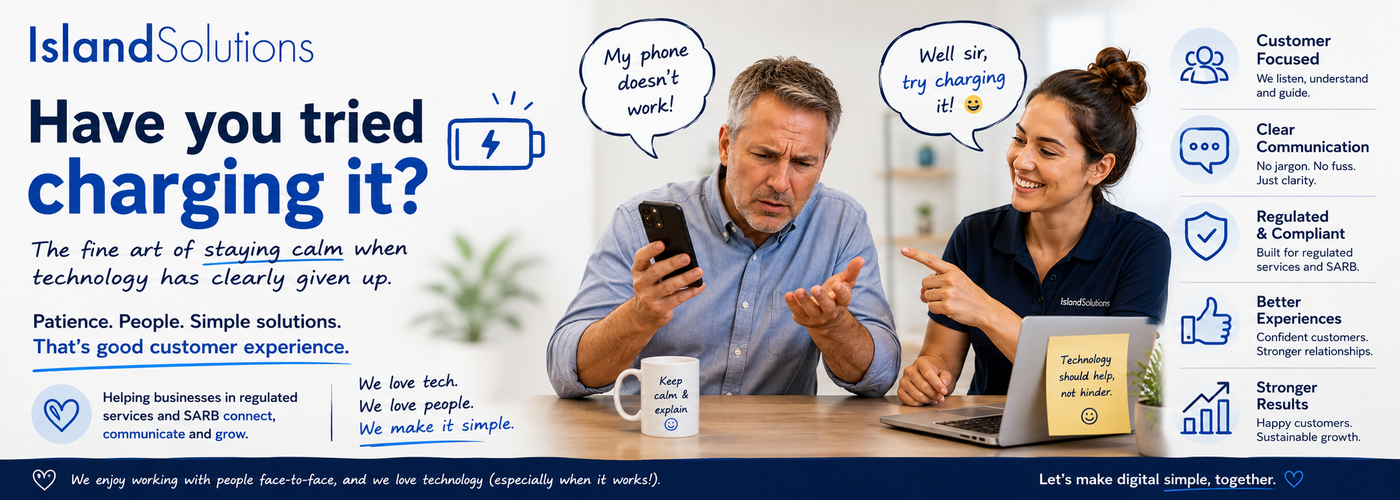
“Have You Tried Charging It?” — The Fine Art of Staying Calm When Technology Has Clearly Given Up
At Island Solutions we spend a lot of time around technology. Marketing platforms, CRMs, analytics dashboards, compliance systems social media scheduling tools. Password resets that somehow require three emails, two text messages, and a small emotional breakdown.
And yet, despite all the advances in digital transformation, cloud computing, AI, automation, and every other buzzword LinkedIn has aggressively forced into our eyeballs recently… one thing remains beautifully consistent:
Someone, somewhere, is still saying: “My phone doesn’t work!”, closely followed by: “Have you tried charging it?”
Now, before we all pretend we’re above this — let’s be honest — every single one of us has had a moment where technology made us feel either:
- Completely helpless, or
- Ready to launch a laptop directly into the sea.
Particularly in regulated industries and sectors like Sale and Rent Back (SARB) entering the marketing arena, where systems, portals, security steps, and digital processes can sometimes feel less “streamlined customer journey” and more “escape room designed by accountants”.
But here’s the thing we’ve learned:
- Most people aren’t stupid.
- They’re just overwhelmed.
And there’s a huge difference.
The Great Technology Panic (We’ve All Been There)
Technology frustration is oddly universal.
You can be:
- A finance director
- A compliance officer
- A business owner
- A marketing manager
- Or someone who confidently uses the phrase “digital ecosystem” in meetings
…and still completely lose composure because your Bluetooth headphones connected to the neighbour’s television instead of your laptop.
Technology has a unique ability to make otherwise intelligent people feel like they’ve accidentally travelled forward in time without instructions.
And in customer-facing businesses, especially regulated services, this matters more than people realise.
Because customers rarely remember:
- Which platform you used
- Which software you integrated
- Or what version of the app they downloaded
What they *do* remember is:
- Whether they felt confused
- Whether someone listened
- Whether they were made to feel silly
- And whether the experience felt stressful or supportive
That emotional side of technology is often ignored, but it’s arguably the most important bit.
“User Error” Sounds Funny… Until It’s Your Mum
There’s always a temptation in business to blame “user error”.
And yes, occasionally the issue genuinely is:
- The device not being plugged in
- Wi-Fi being turned off
- The brightness being on zero
- Caps Lock attacking someone’s password for the fifth consecutive time
But here’s the uncomfortable truth:
If lots of people struggle with something, it’s probably not stupidity. It’s probably poor communication, poor design, or an overcomplicated process. The best digital experiences don’t make people feel clever. They make people feel comfortable. That’s a massive difference.
Particularly in industries like SARB or regulated financial services, customers may already feel stressed, uncertain, or overwhelmed before they even touch your website or digital tools. Throw confusing jargon, endless forms, or complicated instructions into the mix and suddenly the customer journey feels like they’re applying to join MI5 rather than updating account details.
This is why patience matters. Not fake “corporate empathy” patience either, actual patience, the kind where you:
- Listen properly
- Understand what someone is struggling with
- Guide them step-by-step
- And avoid making them feel like they’ve failed a GCSE in Technology
Because most people don’t want perfection, they want reassurance.
The Secret Weapon: Calm Humans
Here’s something surprisingly powerful in modern business: Being approachable.
That’s it, not “leveraging synergistic omnichannel optimisation frameworks.”
Just… being a calm, helpful human. When somebody is frustrated with technology, they’re usually not looking for:
- A lecture
- A technical manual
- Or a 47-minute YouTube tutorial recorded in 2013 with terrifying background music
They want somebody to calmly say: “No problem, let’s sort it together.” That sentence alone lowers stress levels by about 83%.
At Island Solutions, we believe customer experience is becoming less about flashy systems and more about how businesses help people navigate them confidently. Because digital-facing businesses still need human-facing communication. Especially in regulated sectors. The businesses that stand out are rarely the ones with the fanciest software. They’re the ones that make people feel:
- Heard
- Supported
- Understood
- And not judged for accidentally opening 14 browser tabs trying to log into something
Demonstrate, Don’t Overcomplicate
One of the best ways to help customers feel confident with technology is surprisingly simple: Show them.
Live demonstrations, walkthroughs, and simple explanations work brilliantly because they remove fear from the process. People don’t want to feel “sold to.” They want to feel capable. There’s a huge psychological difference between:
- “Buy this digital service because it’s revolutionary”
and: - “Here, let me show you how easy this actually is.”
That second approach builds trust. It also massively improves customer confidence and long-term engagement.
In regulated services and SARB sectors, where trust and clarity are everything, simplicity becomes incredibly valuable. Complicated communication doesn’t make businesses look intelligent. It usually just makes customers nervous. The brands winning right now are the ones translating complexity into clarity.
Customer-Focused and Digital-Facing (Without Becoming Robots)
Modern businesses need to be digitally capable. That’s unavoidable. Customers expect:
- Online access
- Faster responses
- Simpler systems
- Easier communication
- Self-service tools that don’t require a PhD to operate
But becoming digital-first should never mean becoming emotionally disconnected. A genuinely strong customer experience combines:
- Technology
- Communication
- Patience
- Understanding
- And accessibility
The goal isn’t simply to push customers toward digital tools. It’s to help them feel confident using them. That confidence matters, because confident customers:
- Engage more
- Trust businesses more
- Need less repeated support
- And ultimately have a far better experience
And honestly? Sometimes the best customer support isn’t solving the issue immediately. Sometimes it’s simply making people feel calm while solving it.
We Secretly Like Helping People Figure Things Out
One thing we genuinely enjoy at Island Solutions is helping people feel less intimidated by technology. Not because we think technology is magical, but because we know how frustrating it can feel when something that should be simple suddenly becomes bizarrely complicated. There’s something oddly satisfying about watching someone go from:
- “I have absolutely no idea what I’m doing”
to: - “Oh… that’s actually quite easy.”
That confidence boost matters. And in many ways, modern marketing is becoming less about shouting messages at people and more about improving experiences. Helping people navigate digital spaces comfortably is part of marketing now.
Customer experience, communication, accessibility, and trust are all connected. Especially in regulated sectors where reassurance matters just as much as functionality.
Technology Is Great… Until It Isn’t
Technology will continue evolving. Apps will update themselves at inconvenient moments. Passwords will continue disappearing into the void. Printers will remain powered almost entirely by spite.
But the businesses people remember won’t necessarily be the most advanced.
They’ll be the ones that stayed patient.
The ones that communicated clearly.
The ones that helped people feel capable instead of confused.
At Island Solutions, we think that matters.
Because behind every “user error” is usually just a human being trying their best while technology has a small existential crisis.
And honestly? We’ve all been there.